

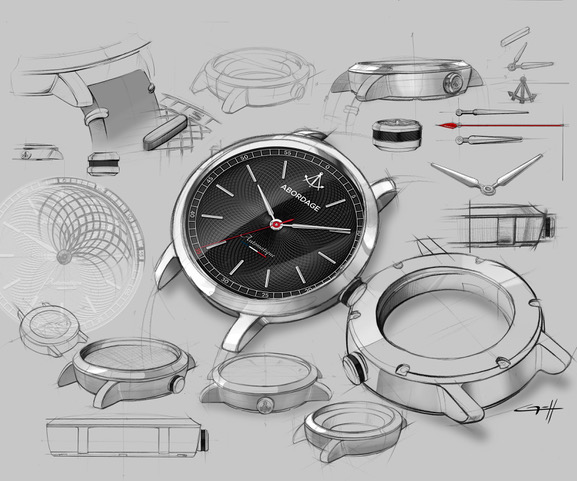
When we created Abordage, we didn’t just have in mind the idea of launching a new watch brand. What truly drove us was the desire to bring meaning back to an object we wear every day on our wrist: a watch that tells a story—one rooted in tradition, exploration, and innovation—echoing those onboard instruments that helped generations of sailors find their way.
The starting point of our Abordage journey
Abordage was born from a simple yet demanding ambition: to pay tribute to a watchmaking and maritime heritage that has always fascinated us. Through Abordage, we aim to highlight the French—particularly Breton—watchmaking legacy, as well as the men for whom horology, especially marine chronometry, was an essential tool for navigating the oceans.
Even before sketching our first watch, we asked ourselves a question: if we were to imagine today a timekeeping instrument inspired by those that once guided ships, what would it look like? We didn’t want to replicate historical marine instruments, but rather reinterpret their spirit—robustness, legibility, reliability, and that very special connection with the horizon.
From this reflection emerged the idea of an independent house, rooted in French watchmaking and deeply connected to a maritime world. We chose the name “Abordage” because it evokes action, decision, and the moment of commitment. That is exactly what we wanted to do: embark on an adventure greater than ourselves—and invite others to follow.
The genesis of our creations
Every Abordage collection begins with a story. Before the first sketch, we define the universe in which the watch will exist: which sailors, which journeys, which instruments, which tributes do we want to evoke?
We always start from purpose and symbolism. What is this watch meant for? What role does it play in the life of the person wearing it? Is it a navigation companion, an everyday instrument, a bridge between the office and the open sea? Once these questions are answered, the design process begins: volumes, proportions, textures—everything is crafted to remain faithful to that original narrative.
At Abordage, we do not seek to multiply references endlessly. We prefer to create coherent collections, where every detail has meaning, rather than simply applying a maritime aesthetic to an existing case. This commitment guided us in the creation of our first collection: 1712.
1712, our first collection
1712 marks the year when the corsair Duguay-Trouin returned Noguette to Saint-Malo. He was one of the highest-ranking officers in Louis XIV’s Royal Navy. Given his rank and history, we chose to pay tribute to him through our “dress / sport chic” watch collection—designed as contemporary marine instruments, capable of transitioning seamlessly from everyday wear to more formal occasions.
We wanted 1712 to be our manifesto: an automatic watch designed from a blank page, shaped by our story and values—sea, naval architecture, and onboard instruments. Designing an Abordage watch means being uncompromising on every detail, pushing the balance between performance, technique, and aesthetics. On the 1712, every line, every volume, every material choice reflects this ambition.
A watch designed as a contemporary marine instrument
Abordage was born facing the ocean, and the 1712 collection naturally carries its imprint. The sea is not a decorative element added afterward—it is the starting point of the watch, from the case structure to the dial details. We drew inspiration from naval architecture, winches, onboard instruments, and the ever-changing reflections of the water’s surface.
A case designed like a ship’s hull
The inward-curving profile of the case is one of the defining signatures of the 1712. It was carefully designed to offer a perfect balance between wearing comfort and dial readability—whether at the office, traveling, or during the weekend. In watchmaking, the case is the “body” of the watch; here, we wanted it to evoke the fluid, tension-filled silhouette of a hull ready to cut through the waves.
This reference to naval architecture expresses the idea of an object built to last—solid, reliable, and designed to withstand the challenges of daily life. For this structure, we chose 316L stainless steel, known for its corrosion resistance, even in saline environments. The alternation of polished and brushed finishes plays with light like sunlight dancing on the sea.
A crown inspired by sailing winches
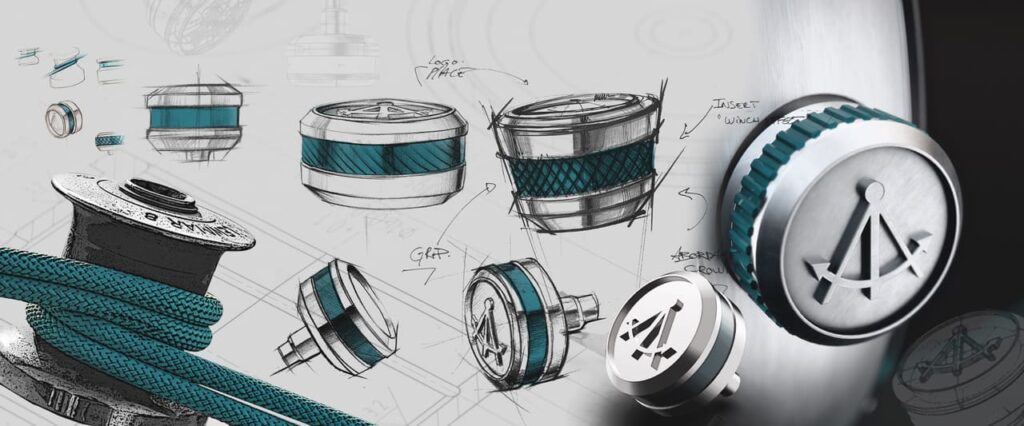
The crown is the direct point of contact between the hand and the watch’s movement. On the 1712, we adorned it with a notched ring matching the dial color—a deliberate nod to the winches of modern sailboats.
On a boat, a winch is used to adjust and tension sails, harnessing the power of the wind. Transposed to a watch, this analogy recalls the crown’s role: setting the time, adjusting it, and winding the automatic movement.
Dial, guilloché, and hands: a subtle play of light
The dial is the face of the watch; its legibility, textures, and interaction with light give it a unique expression. On the 1712, we wanted a living dial—one that subtly changes depending on the angle, like a water surface that can never be fully captured.
Guilloché inspired by the shimmer of the ocean
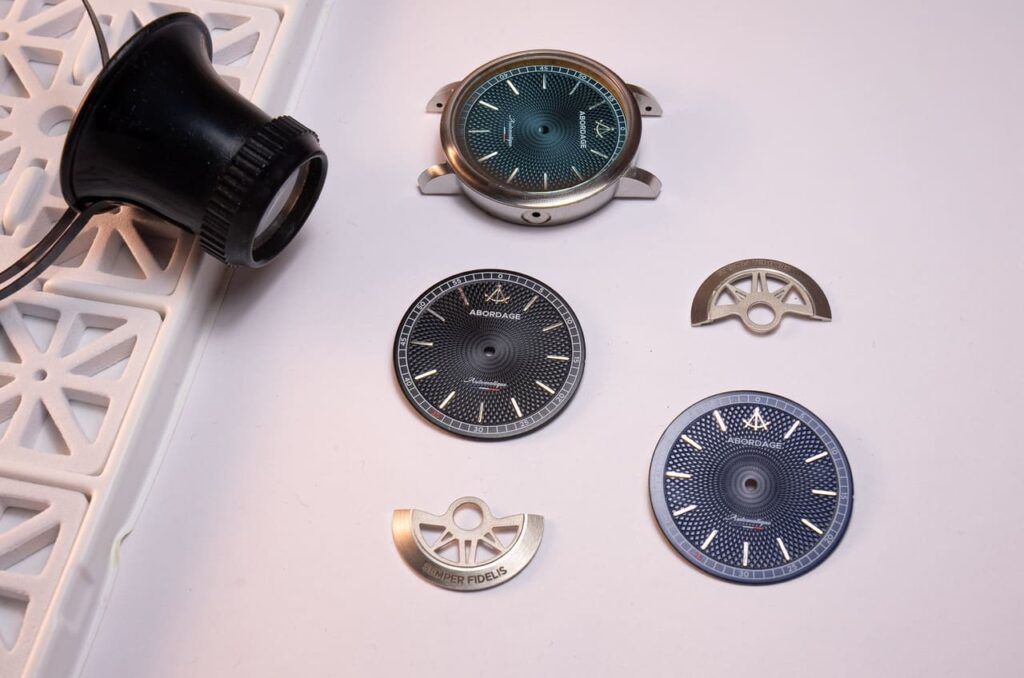
Guilloché occupies a central place in the aesthetic of the 1712. This traditional high-watchmaking technique consists of engraving regular geometric patterns that create depth and relief on the dial.
The patterns we selected evoke wind-driven ripples and the ever-changing reflections of the sea. This textured work structures the dial, enhances legibility from different angles, and brings a true architectural dimension to the design.
Applied indexes and “lance” hands
To complement this decoration, we opted for applied indexes, adding depth and enhancing immediate readability while creating subtle light reflections around each hour marker.
The hands adopt a “lance” shape, chosen for their finesse and timeless elegance. Their slender silhouette appears to float above the guilloché, creating a delicate contrast with the robustness of the case. The 1712 thus asserts its character while offering clear readability in any context.
Our corsair spirit, embedded in every detail
Our roots are deeply maritime, and the corsair world is part of our imagination. Rather than displaying it overtly, we chose to embed these references in subtle details—like on a true navigation instrument, revealed over time.
The red ensign on the seconds hand
The seconds hand stands out with its vivid red color, referencing the red flag raised by corsairs before boarding—a symbol of total commitment and determination.
The number 35, also in red, refers to the Ille-et-Vilaine department code, home to our port of origin. These color accents capture a maritime spirit without confining the watch to a single place.
“Semper Fidelis”, a motto and a promise
On the back of the watch, the transparent case back reveals the automatic movement by France Ébauches, with its oscillating weight engraved “Semper Fidelis.”
This historic motto has become for us a symbol of loyalty—to French watchmaking, its standards, and its independence. This engraving is visible only to the wearer, like a shared secret. It reflects the values of loyalty and rigor that shaped the history of sailors and corsairs, and that the 1712 continues in its own way.
Automatic movement: our vision of sustainable mechanics
Beyond its aesthetics, the 1712 is above all an automatic watch—designed for those who appreciate the living mechanics of traditional timepieces. It does not rely on a battery, but on your movements, your rhythm of life.
Precision mechanics for everyday life
At the heart of the 1712 is a robust automatic movement, made in France, selected for its reliability and timekeeping consistency. The oscillating weight, engraved with our motto, moves with your gestures and winds the mainspring that stores the energy needed to power the watch.
As long as you move, the watch continues to beat on your wrist. This direct relationship between wearer and movement is part of the magic of mechanical watchmaking, echoing the trust sailors once placed in their instruments at sea.
An eco-conscious and heritage-driven approach
Choosing the 1712 also means choosing a durable object. With no battery to replace and a movement designed in France to be serviced and adjusted over time, this watch represents a more responsible alternative to fast consumption.
We advocate for a thoughtful form of luxury: a timepiece worn daily, yet capable of being passed on. The memories of journeys and life milestones experienced with the watch enrich its emotional value over the years.
Who is the 1712 designed for?
Beyond the story and symbolism, why is this watch made for you? We designed the 1712 to be elegant and versatile—equally suited to a suit or a more relaxed weekend outfit. Its maritime-inspired design remains subtle, expressed through lines, textures, and colors.
It is intended for enthusiasts of French watchmaking who resonate with the values of an independent house, for those seeking a characterful automatic watch for everyday wear, and for anyone looking for a timepiece that is both technical, aesthetic, and meaningful. The 1712 stands out through its strong personality and compelling story.
More than a watch, a legacy we write together
The 1712 collection is more than just another French automatic watch. It embodies our vision of watchmaking—where storytelling, materials, and craftsmanship are as important as mechanical precision.
From the hull-inspired case to the winch-inspired crown, from the ocean-reflecting guilloché to the red seconds hand reminiscent of a corsair flag, every detail extends the Abordage universe.
By combining maritime design, a reliable automatic movement, and a tribute to great navigation instruments, the 1712 builds a bridge between the history of sailors and the contemporary lives of those who wear it.
Designing a watch, for us, means sharing a story. Let’s write the next chapter together.